Business
2026
[ARCHIVE_INDEX] · loading entries . . .
Loading accomplishments…
[SUBFILE] · /events/business/ · access granted
The 1981 IBM deal that built an empire, the 1986 IPO at $21 a share, 13 years as the world's richest person — these 157verified business milestones follow Bill Gates from a Harvard dorm room to Microsoft's $500 billion market cap, Cascade Investment, and beyond.
[ARCHIVE_FUNDING] · INDEPENDENT · NO ADS
One developer. >300 verified entries. Zero ads. Forever free.
No sponsors, no paywall, no algorithm. If this archive has been useful to you, reader support is what keeps it running.
2026
In the first quarter of 2026, the Bill & Melinda Gates Foundation Trust sold its remaining Microsoft shares, fully exiting a position in the very company that created Gates's fortune — capping a long, deliberate diversification away from the stock. The endowment that funds Gates's philanthropy, managed separately from its grant-making through Cascade, is now anchored instead by Berkshire Hathaway, Waste Management, railroads, and heavy-equipment makers. The sale underscored how thoroughly Gates's giving had decoupled from Microsoft's day-to-day fortunes.
2026
By 2026, the publicly disclosed stock portfolio of the Bill & Melinda Gates Foundation Trust — the endowment that funds Gates's philanthropy — was led not by Microsoft but by Berkshire Hathaway, Waste Management, Canadian National Railway, Caterpillar, and Deere. Decades of diversification, plus Warren Buffett's stock gifts, left it concentrated in railroads, waste, heavy equipment, and Buffett's conglomerate, while Microsoft — the source of the original fortune — had largely been sold down. The unglamorous, value-oriented mix reflects the long stewardship of Gates's money manager, Michael Larson, through Cascade Investment.
2026
Bill Gates's net worth fell sharply in 2026 as he accelerated his giving, with trackers noting he had become 'much poorer' — Forbes pegged him around $104 billion and 19th on its global ranking, down from his long reign near the top — as he transfers the bulk of his fortune to the Gates Foundation ahead of its 2045 closure. Gates has said he wants to give away about 99% of his wealth and does not want to be remembered as having 'died rich.' Differences between wealth trackers' methodologies, particularly how charitable pledges are counted, produced a wide range of estimates.
February 2026
Satya Nadella revealed that Bill Gates had warned him his early $1 billion bet on OpenAI was a mistake, telling the Microsoft CEO 'yeah, you're going to burn this billion dollars.' The gamble instead became one of the most consequential in tech: a 2025 OpenAI restructuring left Microsoft holding roughly a 27% stake valued around $135 billion, alongside a deal for OpenAI to buy hundreds of billions of dollars of Azure services. The anecdote, surfacing in early 2026, highlighted Gates's continued skepticism even as Microsoft's AI bet paid off.
January 2026
Tax filings reported in January 2026 revealed that Bill Gates had paid his former wife, Melinda French Gates, nearly $7.88 billion as part of their divorce settlement. The disclosure, together with Gates's large charitable giving and his 2021 divorce, helped push his estimated net worth to roughly $104 billion — ranking him around 19th on global wealth indexes and out of the world's ten richest people for the first time in about three decades. Gates has repeatedly said he intends to give away nearly all of his fortune and fall far down the rankings as the Gates Foundation spends toward its planned 2045 closure. Melinda French Gates, who left the Foundation in 2024, was separately estimated to be worth tens of billions of dollars.
February 2025
In an interview published in early 2025, Bill Gates reiterated his deep skepticism of cryptocurrency, saying it 'has no value' and that 'even people with high IQs are deceiving themselves into believing that cryptocurrency has value.' Gates said he prefers 'investing in things that have value,' owns no cryptocurrency, and views Bitcoin as contributing little to society while raising concerns about its volatility and energy use. He distinguished speculative crypto from regulated digital-currency systems, noting the Gates Foundation has supported transparent digital-payment initiatives in developing countries.
March 2025
Around Microsoft's 50th anniversary, Bill Gates reflected on the company's leadership and future, praising CEO Satya Nadella's transformation of Microsoft into a cloud-and-AI powerhouse and discussing the importance of succession and stable leadership. Gates, who stepped down as CEO in 2000 and left the board in 2020, has credited Nadella and predecessor Steve Ballmer for management strengths he said complemented his own engineering focus. His remarks came as Microsoft leaned heavily into AI through its OpenAI partnership and Copilot products.
2025
Bill Gates remained the largest private owner of farmland in the United States, holding roughly 275,000 acres across at least 17 states according to the 2025 Land Report — a position that has made him a lightning rod for critics who argue such concentrated ownership poses risks to traditional farming and the food supply. Gates has said the holdings amount to less than a quarter of one percent of U.S. farmland, are managed by a professional investment team, and reflect investments to make farms more productive rather than 'some grand scheme.' Most acquisitions were made between 2017 and 2018.
January 2024
A January 2024 investigation by The Guardian and Floodlight News revealed that entities connected to Bill Gates's Cascade Investment had used a network of limited liability companies — including Cottonwood Ag Management — to quietly purchase approximately 20,588 acres of Nebraska farmland valued at roughly $113 million, without disclosing the beneficial owner to local sellers or county officials. The acquisitions were part of Gates's wider strategy to become the largest private farmland owner in the United States, with holdings exceeding 269,000 acres across 18 states, managed through Cottonwood Ag Management and its parent Leading Harvest, which develops regenerative agriculture certification standards.
2024
Breakthrough Energy Ventures closed its third fund at $839 million, with food and agriculture as one of five core investment sectors alongside power, transportation, manufacturing, and buildings. The fund holds stakes in approximately 20 agricultural companies and requires each portfolio company to demonstrate a credible pathway to avoiding at least 500 million tons of CO₂-equivalent emissions annually by 2050. The 20-year investment horizon is deliberately longer than standard venture capital to reflect the time required to change biological and physical infrastructure at scale.
2023
In October 2023, Microsoft disclosed that the U.S. Internal Revenue Service was seeking about $28.9 billion in back taxes, plus penalties and interest, over how the company allocated profits among countries between 2004 and 2013 — years when Bill Gates was Microsoft's chairman. The dispute centers on 'transfer pricing,' including a Puerto Rico manufacturing arrangement that the IRS said let Microsoft shift a large share of U.S. revenue into lower-tax jurisdictions. Microsoft said it disagreed with the IRS's position, believed it had followed the rules, and would contest the claim through the agency's appeals process and potentially the courts — a fight expected to take years. It ranks among the largest tax disputes in U.S. corporate history.
2023
In February 2023 Bill Gates bought a roughly 3.8% stake in Heineken Holding worth about 850 million euros (around $900 million), acquiring the shares as Mexico's FEMSA sold down its position in the Dutch brewer. The investment drew attention given Gates's well-known disinterest in alcohol; he acknowledged he is 'not a big beer drinker.' The purchase was another example of Cascade Investment's value-oriented, often unflashy bets on established consumer and industrial companies far afield from technology.
June 2023
Gates-backed UPSIDE Foods (originally Memphis Meats) became one of the first two companies to receive USDA authorization to sell cultivated — or lab-grown — chicken in the United States in June 2023. Gates had invested in Memphis Meats as early as 2016 and participated in the company's $400 million Series C funding round. UPSIDE Foods grows real animal muscle tissue from cells in bioreactors, requiring no slaughter and dramatically fewer land, water, and feed inputs than conventional poultry production. Gates has cited cultivated meat as one of the most promising technologies for reducing livestock agriculture's 14.5% share of global greenhouse gas emissions.
May 2022
In April 2022, Elon Musk publicly alleged — and a leaked text exchange appeared to corroborate — that Bill Gates had taken a short position of roughly $500 million against Tesla, betting its share price would fall, while Gates was separately seeking to discuss climate philanthropy. According to Musk, when he asked whether Gates still held the short, Gates replied that he had not closed it; Musk said he then declined to collaborate, telling Gates he could not take his climate philanthropy seriously while Gates was 'shorting Tesla, the company doing the most to solve climate change.' Gates has not publicly disputed holding a short position but has not confirmed its size, and neither man has released trading records to substantiate the reported figure — the characterization rests largely on Musk's account. The reported wager, seemingly at odds with Gates's climate advocacy, fueled a public feud between the two billionaires.
April 2022
Upside Foods (formerly Memphis Meats) raised a $400 million Series C round — achieving a valuation exceeding $1 billion — with participation from Bill Gates alongside Temasek, SoftBank Vision Fund 2, Cargill, Tyson Foods, and Abu Dhabi Growth Fund. The round was the largest ever for a cultivated meat company and gave Upside the capital to build its first commercial-scale Engineering, Production, and Innovation Centre in Emeryville, California. USDA approval for its cultivated chicken followed in June 2023.
2021
Through his Cascade Investment vehicle, Bill Gates is the largest shareholder of Republic Services, the second-biggest U.S. waste-hauling company, and his longtime money manager has sat on its board. The company has drawn criticism that sits awkwardly with Gates's environmental image: in 2021, Teamsters-represented sanitation workers staged strikes accusing Republic of labor-law violations, with some protesting outside Gates-linked events, and the company has faced environmental enforcement actions over problems including landfill fires. Republic has defended its labor and environmental record. The holding highlights tensions between Gates's green public profile and his investment portfolio.
2021
In 2021, The New York Times and Business Insider reported allegations of workplace misconduct by Michael Larson, the longtime head of Cascade Investment, the private firm that has managed and diversified Bill Gates's fortune since 1994. Former employees alleged that Larson made racist and sexist remarks, bullied staff, and fostered a 'culture of fear'; the Times reported that Cascade had reached settlements with several people who had complained. Larson acknowledged occasionally using harsh language but denied mistreating employees, and Cascade defended his conduct and decades-long investment record. The reporting drew scrutiny to the secretive operation underpinning Gates's wealth; the allegations have not been tested in court.
2021
Bill Gates's Cascade Investment has held a large stake in Caterpillar, the world's biggest maker of construction and mining machinery, since around 2005, a position worth several billion dollars and among Gates's top public holdings. The investment is emblematic of Cascade's tilt toward heavy-industry and infrastructure companies that generate steady cash, part of a deliberately unflashy portfolio.
2021
Through Cascade Investment, Bill Gates is one of the largest shareholders of Deere & Company, the maker of John Deere tractors and agricultural equipment, holding around a tenth of its stock. The stake — one of Cascade's anchor positions — fits Gates's interest in agriculture and food security and his preference for established, essential-economy businesses far removed from technology.
2021
Through Cascade Investment, Bill Gates is the largest shareholder of Ecolab, the global water, hygiene, and infection-prevention company, holding roughly a quarter of its stock. The long-held position is one of Cascade's anchor investments and fits Gates's pattern of backing established companies tied to essential services. It also dovetails with his philanthropic interests in clean water and sanitation, though the stake is a personal investment managed separately from the Gates Foundation.
2021
In 2021 a consortium including Bill Gates's Cascade Investment, Blackstone, and Global Infrastructure Partners acquired Signature Aviation — the world's largest operator of private-jet bases — in a deal valued at about $4.7 billion. Cascade, already Signature's biggest shareholder, increased its stake through the take-private transaction. The acquisition deepened Gates's exposure to global infrastructure and, notably, to the private-aviation business he personally relies on.
2021
For years Bill Gates, through Cascade Investment, was the single largest shareholder of Canadian National Railway, one of North America's biggest freight railroads — at one point holding more than 100 million shares worth over $13 billion. The position reflected Gates's appetite for durable infrastructure assets. He has since trimmed the holding substantially, and additional shares passed to Melinda French Gates as part of their 2021 divorce settlement.
2021
Through his investment vehicle Cascade Investment, Bill Gates is the largest shareholder of Republic Services, the second-biggest waste-collection and recycling company in the United States — holding roughly a third of its shares. The stake, worth many billions of dollars, is among Cascade's largest positions and exemplifies Gates's preference for steady, cash-generating businesses far removed from technology. It is one of several large industrial holdings through which Gates has diversified his fortune beyond Microsoft.
2021
In 2021 Bill Gates's investment firm, Cascade Investment, took majority control of luxury hotel chain Four Seasons Hotels and Resorts, paying about $2.2 billion to buy half of the stake held by Saudi Prince Alwaleed bin Talal's Kingdom Holding. The deal lifted Cascade's holding to roughly 71% and valued Four Seasons at about $10 billion. It deepened Gates's eclectic, long-running portfolio — spanning farmland, railroads, and waste management — built through Cascade as he diversified far beyond Microsoft stock.
2021
Cottonwood Ag Management — the entity overseeing Bill Gates's 269,000-acre US farmland portfolio — provided founding support for Leading Harvest, a nonprofit that developed a third-party sustainability certification standard for large-scale row-crop farming. Leading Harvest's standard covers soil health, water quality, biodiversity, and worker welfare across continuous-cultivation cropland; it targets institutional farmland investors seeking ESG certification analogous to FSC for timber. Critics noted that the standard does not require carbon sequestration targets or limit synthetic fertiliser use.
July 2021
Breakthrough Energy Ventures — Bill Gates's climate investment fund — led a $75 million Series B in Nobell Foods, which genetically programmes soybean plants to express casein — the dairy protein responsible for cheese's stretch, melt, and mouthfeel — without any cows. Total funding reached $100 million. By producing cheese proteins inside soybean plants rather than dairy cows, Nobell targets a significant source of agricultural methane and land-use emissions while maintaining the functional characteristics that define traditional cheese.
2021
Breakthrough Energy Ventures participated in Perfect Day's $350 million funding round, backing the company's precision fermentation platform that uses fungal microflora to produce whey and casein proteins identical to dairy cows — without any animals. Perfect Day's proteins can be used in ice cream, milk, and cheese with the same taste profile as conventional dairy but requiring a fraction of the water, land, and greenhouse gas emissions. The company partners with major food manufacturers to integrate its proteins into mainstream consumer products.
November 2021
Bill Gates participated as a continuing investor in Impossible Foods' $500 million Series G in November 2021, led by Mirae Asset Global Investments, valuing the company at approximately $7 billion. Impossible Foods had by this point expanded to Impossible Pork, Chicken, and Beef across more than 30,000 grocery stores and 45,000 restaurants in 22 countries. The investment continued a relationship from Gates's participation in the 2017 Series C and his public advocacy for plant-based protein as a climate technology.
2021
By 2021, Bill Gates — through his personal investment firm Cascade Investment and land management subsidiary Cottonwood Ag Management — had become the largest private farmland owner in the United States, with approximately 242,000 acres across 19 states including Louisiana (69,000 acres), Arkansas (47,900 acres), and Nebraska (20,600 acres). Gates has described the farmland investments as driven by interest in agricultural productivity innovation rather than land appreciation, with Cottonwood working with tenant farmers on soil health and sustainable practices. Total holdings have since grown to approximately 275,000 acres.
2021
Beyond Louisiana and Arkansas, Bill Gates's farmland holdings through Cascade Investment include significant parcels in Nebraska (approximately 20,000 acres), Arizona (approximately 25,750 acres in the San Luis Valley area), California (San Joaquin Valley), North Dakota, Wyoming, Colorado, Minnesota, and several other states. The geographically diversified portfolio includes irrigated row-crop land, dry-land grain farms, and potato-producing land.
2021
Arkansas, a leading rice and soybean producer, is Gates's second-largest state-level farmland holding through Cascade Investment, with approximately 47,000 acres identified in the 2021 Land Report analysis. Like most Cascade farmland properties, the Arkansas parcels are leased to working farmers and managed for both agricultural returns and long-term asset value.
2021
Louisiana — one of the most productive soybean and corn states in the American South — hosts Gates's largest state-level farmland block, estimated at approximately 69,000 acres by the Land Report. The properties are leased to commercial farming operators and managed by Cascade Investment for long-term agricultural income and land appreciation. Louisiana's fertile alluvial soils along the Mississippi and Red Rivers made it an attractive target for the portfolio.
January 2021
The Land Report's 2021 annual ranking of America's 100 largest private landowners placed Bill Gates first for farmland, with over 269,000 acres spread across at least 18 states. The holdings — operated through Cascade Investment and subsidiary LLCs — had not been publicly disclosed; the ranking was compiled from county property records. A Gates spokesperson confirmed the holdings and said the farmland investments were made by Cascade's full-time team of professional asset managers.
July 6, 2021
The Department of Defense scrapped the JEDI cloud contract with Microsoft after years of legal challenges from Amazon and mounting procurement scrutiny, announcing it would pursue a multi-vendor approach called JWCC instead. The Pentagon stated JEDI no longer met its needs due to evolving requirements and industry advances. Microsoft subsequently secured a significant portion of the follow-on JWCC contract, limiting its losses. The JEDI saga became a high-profile case study in the legal and political risks of winner-take-all mega-contracts in government technology procurement.
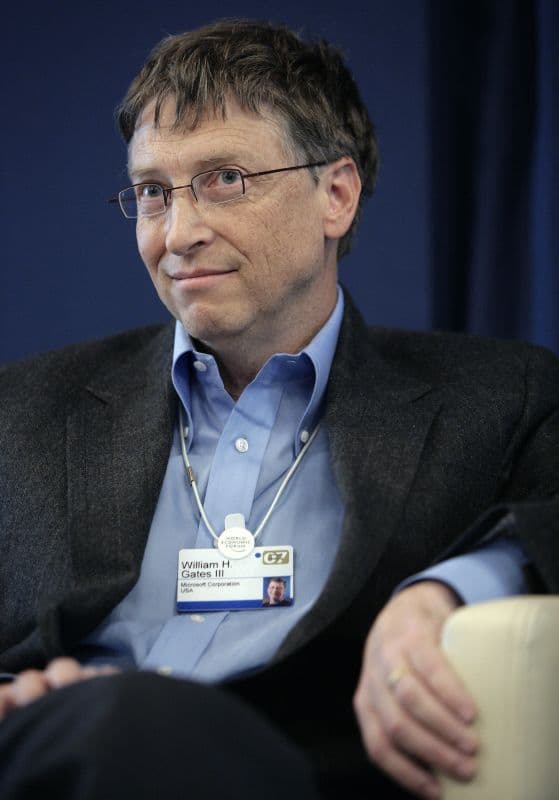
2021
Through Cascade Investment, Gates accumulated approximately 242,000 acres of farmland across 18 US states, making him the largest private farmland owner in the country according to The Land Report. Holdings span Louisiana, Arkansas, Nebraska, Washington, and other states. Gates cited agricultural innovation and food security as motivations. The disclosure drew significant public and political attention.
2020
In March 2020, Bill Gates resigned from the board of Berkshire Hathaway, where he had served since 2004 alongside his close friend Warren Buffett, at the same time he left Microsoft's board. Gates said he was stepping back from corporate boards to devote more time to philanthropy. Former American Express chief Kenneth Chenault took his Berkshire seat. The departures marked Gates's near-complete exit from formal corporate governance, even as Berkshire stock remained the largest holding funding his foundation.
2020
Bill Gates was an early and major backer of Schrödinger, a company whose software uses physics-based computation and machine learning to speed the discovery of new drugs and materials. Gates personally led several funding rounds beginning in 2010, and the Gates Foundation held a roughly 18% stake heading into Schrödinger's February 2020 IPO, which raised about $232 million. The investment reflected Gates's long-held bet that computation could transform the slow, costly process of discovering new medicines.
March 2020
Breakthrough Energy Ventures — Bill Gates's climate investment fund — co-led an $80 million Series B round in Nature's Fynd alongside Generation Investment Management. Nature's Fynd produces Fy protein from a Fusarium-strain microorganism discovered in Yellowstone geothermal springs, fermented from food waste. The complete protein contains all nine essential amino acids and can be formed into meat, dairy, and egg substitutes without farmland, irrigation, or livestock, requiring a fraction of the land and water of conventional animal agriculture.
April 2020
Breakthrough Energy Ventures — Bill Gates's climate investment fund — co-led a $100 million Series C funding round for Pivot Bio at a $410 million valuation. Pivot Bio engineers naturally occurring soil microbes to colonise corn roots and produce nitrogen on demand, replacing a portion of synthetic nitrogen fertiliser. Synthetic nitrogen production accounts for roughly 1.5 percent of global CO₂ emissions and runoff causes widespread aquatic dead zones. Pivot Bio's microbes also reduce farmers' input costs while improving yields, creating a commercial incentive aligned with environmental benefit.
2019
In a 2019 talk, Bill Gates candidly called Microsoft's failure to win the smartphone market his 'greatest mistake ever,' estimating it had cost the company on the order of $400 billion. 'The greatest mistake ever is whatever mismanagement I engaged in that caused Microsoft not to be what Android is,' he said, calling a dominant non-Apple phone platform 'a natural thing for Microsoft to win' that it lost partly through his own missteps and the distraction of its antitrust battles. The remark was a rare, blunt self-assessment of his biggest business failure.
2019
Bill Gates has repeatedly said the wealthy — himself included — should pay more in taxes. In a 2019 Reddit session and interviews, Gates noted he had paid more than $10 billion in taxes over his lifetime, 'more than anyone,' but argued he 'should have had to pay more' and called for a more progressive system, including higher taxes on capital gains and large estates. The stance, echoing his father's advocacy, set him apart from many ultra-wealthy peers even as critics noted his fortune kept growing.
February 2019
Breakthrough Energy Ventures joined Fonterra and Louis Dreyfus Company in a $90 million Series A to spin Motif Ingredients (later Motif FoodWorks) out of Ginkgo Bioworks. The company uses precision fermentation to produce proteins replicating dairy, egg, and meat properties for plant-based foods. BEV also participated in Motif's $226 million Series B in June 2021. Motif's HEMAMI — an FDA-approved plant heme iron protein — imparts authentic meaty flavour to plant-based products, addressing the sensory gap limiting mass adoption of animal-free proteins.
September 2019
Gates made a $55 million pre-IPO equity investment in BioNTech, the German biotech company developing mRNA-based vaccines for HIV, tuberculosis, and influenza. The stake predated any COVID-19 pandemic by months. When BioNTech's mRNA COVID-19 vaccine — developed in partnership with Pfizer — became one of the most widely used vaccines in history, the investment returned an estimated $550 million. The timing cemented Gates's early conviction in mRNA as a platform technology.
October 25, 2019
The U.S. Department of Defense awarded Microsoft its Joint Enterprise Defense Infrastructure (JEDI) cloud computing contract — a potential $10 billion, ten-year deal to modernize the Pentagon's IT and AI infrastructure. Microsoft beat Amazon Web Services in the final competition, a result Amazon immediately contested in court, alleging that President Trump's antagonism toward Amazon CEO Jeff Bezos had tainted the evaluation process. The JEDI award was one of the most consequential and contentious government technology contracts in history and extended Microsoft's deep relationship with the Department of Defense.
May 2018
Cascade Investment, Bill Gates's personal investment firm, committed $275 million to Ginkgo Bioworks, a synthetic biology platform company that designs and engineers microorganisms for industrial and agricultural applications. Among Ginkgo's agricultural programmes is a $100 million collaboration with Bayer to engineer microbes enabling staple crops including corn, wheat, and soybeans to fix their own atmospheric nitrogen — potentially disrupting the $250 billion global synthetic fertiliser market and dramatically reducing the land-use and emissions footprint of grain production.
2017
Bill Gates invested in Impossible Foods' $75 million Series B funding round. Impossible Foods produces plant-based burgers using soy leghemoglobin — a genetically engineered protein — to replicate the taste and texture of beef. Independent life-cycle analyses estimate that Impossible products require 87 percent less greenhouse gas, 95 percent less land, and 74 percent less water than conventional beef per kilogram of protein. Gates's stake aligned with his broader thesis that shifting protein systems is one of the highest-leverage climate interventions available.
August 2017
Bill Gates co-invested in Memphis Meats' $17 million Series A round, which also included Richard Branson, Cargill, and Kimbal Musk. Memphis Meats grows real animal muscle cells in bioreactors to produce chicken, beef, and duck without slaughtering animals, eliminating the land clearing, water consumption, and methane emissions associated with conventional livestock. The company later rebranded as Upside Foods and in June 2023 became the first cultivated meat company to receive USDA approval for commercial chicken sales.
2016
In January 2016, Bill Gates sold Corbis — the image-licensing company he founded in 1989, home to the 16-million-image Bettmann Archive and the Sygma collection — to Unity Glory, an affiliate of China's Visual China Group (VCG). VCG, sometimes called 'China's Getty,' took control of the vast trove of Western historical photographs, while Getty Images was tapped to license the collection everywhere except China. The deal ended a decades-long rivalry with Getty and drew some unease about a major archive of 20th-century Western imagery passing to a Chinese company.
2016
Bill Gates announced Breakthrough Energy Ventures at COP21 in Paris alongside 27 other billionaire investors including Jeff Bezos, Richard Branson, and Jack Ma, committing over $1 billion in patient capital to invest in early-stage clean energy companies. The fund explicitly targets the five sectors responsible for virtually all greenhouse gas emissions: electricity generation, agriculture, manufacturing, transportation, and buildings. By 2024, the portfolio included approximately 100 companies spanning energy storage, green hydrogen, sustainable aviation fuel, and carbon removal.
2015
Bill Gates became an early investor in Carbon Engineering, a Canadian company developing industrial direct air capture (DAC) technology to remove CO₂ directly from the atmosphere. Gates joined a syndicate that also included oil majors Chevron, BHP, and Occidental Petroleum. Occidental acquired Carbon Engineering for $1.1 billion in 2023, validating the technology Gates had backed nearly a decade earlier. Carbon Engineering's plant in Texas became one of the world's first commercial-scale DAC facilities.
2014
In February 2014, the anti-censorship group GreatFire.org reported that Microsoft's Bing search engine appeared to censor Chinese-language results for users around the world — not only inside China — returning sharply limited results for sensitive terms such as the Dalai Lama, the Tiananmen Square crackdown and Falun Gong. Microsoft denied deliberately censoring results outside China, attributing the discrepancies to a technical error and to standard removals for spam or legal reasons. GreatFire rejected the explanation, accusing Microsoft of 'deploying Chinese censorship on a global scale.' The controversy renewed scrutiny of how the company founded by Bill Gates accommodated Beijing's censorship demands.
2014
When Satya Nadella became Microsoft's CEO in February 2014, Bill Gates gave up the chairman's role he had held since the company's founding, handing it to lead director John Thompson and taking a new title: 'Founder and Technology Advisor.' Gates pledged to spend roughly a third of his time supporting Nadella on product and technology direction. The shift cemented the generational handover at Microsoft and Nadella's authority to remake the company for the cloud-and-AI era.
2014
In a deal closed in 2014, Microsoft acquired Nokia's mobile-phone business for about $7 billion in a last-ditch attempt to compete in smartphones with Windows Phone. The bet failed badly — Microsoft soon wrote off most of the value and exited the phone market — confirming the mobile defeat that Bill Gates, still a board member, lamented as a costly missed opportunity.
February 4, 2014
Gates resigned as non-executive Chairman of Microsoft's Board of Directors — a role he had held since co-founding the company — on the same day Satya Nadella was named CEO. Gates took on a new role as technology advisor, spending roughly a third of his time with the company for the next several years. The transition marked the formal end of Gates's operational connection to the company he had built over 39 years.
2013
Between late 2012 and 2013, Microsoft — with Bill Gates as chairman — ran 'Scroogled,' a sustained negative-advertising campaign attacking rival Google. Devised by political strategist Mark Penn, the campaign accused Google of scanning Gmail users' messages to target ads and of skewing shopping results toward paying advertisers, and urged consumers to switch to Microsoft's Bing and Outlook.com. Microsoft even sold anti-Google 'Scroogled' merchandise. Critics, and some inside the tech industry, derided the effort as a cynical, fear-based attack rather than competition on product quality, and Microsoft wound the campaign down after about a year. It stood out as an unusually combative corporate-rival tactic from the company Gates built.
2013
In 2013, Bill Gates joined a $35 million funding round for ResearchGate, a Berlin-based social network for scientists to share papers and data — sometimes dubbed the 'Facebook for scientists.' Gates said the platform aligned with his goal of opening up science to speed discovery and disease eradication. The bet reflected his belief that better tools for collaboration among researchers could accelerate progress on the global-health problems his foundation works on.
2013
In June 2013, documents leaked by Edward Snowden to The Guardian and The Washington Post identified Microsoft — where Bill Gates remained chairman — as the first company enrolled, in 2007, in the U.S. National Security Agency's PRISM surveillance program. Subsequent reporting alleged Microsoft had helped the government access user communications, including engineering a way around its own encryption on Outlook.com and easing NSA access to SkyDrive and Skype. Microsoft denied granting any government direct or blanket access, saying it turns over customer data only in response to lawful, specific legal demands. The disclosures made the company a flashpoint in the debate over tech firms and state surveillance.
2013
In October 2013, Bill Gates — through his investment vehicle Cascade Investment — paid about €113.5 million (roughly $155 million) for a 6% stake in Fomento de Construcciones y Contratas (FCC), one of Spain's largest construction and environmental-services groups, making him its second-largest shareholder. The contrarian bet on a debt-laden builder as Spain emerged from financial crisis was characteristic of Cascade's value-oriented strategy of taking large positions in unglamorous, essential-economy companies far from the technology world.
October 2013
Bill Gates invested in Beyond Meat after personally tasting the company's plant-based chicken and describing it as indistinguishable from real meat. Beyond Meat's products use pea protein and other plant inputs and are estimated to require 99 percent less water, 93 percent less land, and generate 90 percent fewer greenhouse gas emissions than conventional beef production per kilogram. Gates's early backing helped legitimise plant-based meat as a technology category for subsequent institutional investors.
2013
Gates invested in Impossible Foods in 2013 — one of the earliest outside investors — backing the company's mission to make plant-based meat that replicates the taste and texture of conventional meat using a fraction of the land, water, and greenhouse gas emissions. Impossible Foods' signature product uses soy-derived heme to replicate the bloody, savory taste of beef. Gates has repeatedly cited plant-based and cultivated meat as essential components of any serious climate strategy, arguing that livestock agriculture — responsible for 14.5% of global greenhouse gas emissions — cannot be decarbonized without transforming protein production itself.
March 2013
The European Commission fined Microsoft $732 million for failing to display the browser ballot screen — a legally required prompt giving European Windows users a choice of web browsers — in Windows 7 Service Pack 1. Microsoft had committed to showing the ballot for five years as part of a 2009 consent decree. The failure affected users from February 2011 to July 2012. EU antitrust chief Joaquin Almunia called it the first time the Commission had fined a company for breaching a legally binding commitment. Microsoft did not contest the fine.
November 2013
Gates joined Warren Buffett and casino magnate Sheldon Adelson — spanning the ideological spectrum — in a joint New York Times op-ed urging Congress to pass comprehensive immigration reform. The trio argued the United States was turning away highly productive potential citizens and that strong bipartisan business consensus existed to fix the broken system. The unusual cross-ideological coalition drew significant attention at a moment when comprehensive reform legislation was stalled in the Senate.
2012
A 2012 investigation by the U.S. Senate Permanent Subcommittee on Investigations, led by Senator Carl Levin, found that Microsoft had used subsidiaries in Puerto Rico, Ireland, Singapore and Bermuda to shift profits offshore and avoid more than $6.5 billion in U.S. taxes over three years. The report detailed how Microsoft routed nearly half of its U.S. revenue through a Puerto Rican affiliate to cut its tax bill. Levin stressed that Microsoft had broken no laws and was exploiting loopholes Congress created, and Microsoft said it complied fully with U.S. tax rules. The findings put Microsoft — the company Bill Gates founded and then chaired — at the center of the debate over corporate tax avoidance.
2011
In 2009, a federal jury found that Microsoft Word had infringed a custom-XML patent held by i4i, a small Toronto software company, and awarded i4i about $290 million — one of the largest patent verdicts against Microsoft. Microsoft appealed all the way to the U.S. Supreme Court, seeking to make patents easier to invalidate, but in June 2011 the Court ruled unanimously against it, affirming the verdict and the demanding 'clear and convincing evidence' standard for overturning a patent. Microsoft was forced to remove the infringing feature from Word. The defeat, during Bill Gates's tenure as Microsoft chairman, was a notable setback in the company's long history of patent litigation.
2011
In 2011, Bill Gates co-led the seed financing of Nimbus Therapeutics (originally Nimbus Discovery), a biotech built around using computer modeling to design new medicines — partnering closely with Schrödinger, another Gates-backed firm. Nimbus pioneered an unusual structure that spun out drug programs as separate subsidiaries; one of them was later sold to Takeda for billions. The investment fit Gates's recurring thesis that computation could make the slow, costly hunt for new drugs faster and smarter.
2011
In 2011 Microsoft acquired the internet-calling service Skype for about $8.5 billion — its largest acquisition at the time — while Bill Gates served as chairman of the board. Skype was folded into Microsoft's communications products and later largely superseded by Teams, but the deal underscored Microsoft's drive to own how people connect online in the years after Gates stepped back from daily management.
2010
SEC 13-F filings revealed that the Bill & Melinda Gates Foundation Trust purchased approximately 500,000 shares of Monsanto Company — then the world's largest agricultural biotechnology company — in 2010, valued at roughly $23 million. The investment attracted criticism from advocacy groups who argued it signalled foundation support for Monsanto's model of patent-protected seeds and herbicide-tolerant crops. The Foundation stated that investment decisions are separate from its grant-making. The position was subsequently reduced and eventually sold.
2008
Microsoft's effort to have its Office Open XML (OOXML) document format ratified as an international standard by ISO in 2007–2008 was dogged by allegations of vote manipulation. National standards bodies in several countries were suddenly flooded with new Microsoft-aligned members; in Sweden, Microsoft acknowledged that a partner had offered 'marketing incentives' to companies to join and back OOXML, and Sweden voided its vote after irregularities, including a participant voting twice. Critics said Microsoft pressured and packed committees to win approval over the rival OpenDocument format. After an initial rejection and a contentious second ballot, OOXML was approved in 2008, but representatives from multiple countries protested that the process had been inadequate. The affair, during Bill Gates's chairmanship, became a notorious example of standards-body manipulation.
2008
Bill Gates personally lobbied Congress to raise or eliminate the cap on H-1B skilled-worker visas, telling lawmakers in 2007 and 2008 that a shortage of visas left high-tech jobs unfilled and pushed work overseas, and arguing the limits bore 'no relation' to the economy's need for talent. Critics — including some senators and labor economists — countered that expanding the program would suppress wages for American technology workers and let companies substitute lower-paid foreign labor, and they pressed for stronger worker protections. The clash made Gates a leading corporate voice in a long-running and contentious debate over skilled immigration and its effect on U.S. wages.
2008
In 2008, after stepping back from full-time work at Microsoft, Bill Gates formally established bgC3 ('Bill Gates Catalyst 3') — a private think tank and holding company housing his personal staff, research interests, and technology investments. Later renamed Gates Ventures, the entity became the engine behind Gates Notes, his books, and his many science and energy bets. It marked the institutional beginning of Gates's 'third career' beyond Microsoft and the foundation.
2008
In February 2008, the European Commission fined Microsoft a then-record €899 million for failing to comply with its 2004 antitrust order — specifically for charging rivals 'unreasonable' prices for the technical information needed to make their products interoperate with Microsoft's dominant server software. It was the first time in 50 years of EU competition policy that the Commission penalized a company for non-compliance with an antitrust decision. Microsoft, chaired by Bill Gates, called the fine unfair and appealed; a court later trimmed it slightly to €860 million.
2008
On February 1, 2008, Microsoft — with Bill Gates as chairman — launched an unsolicited $44.6 billion bid (about $31 per share, a 62% premium) to acquire the struggling internet pioneer Yahoo, hoping to combine forces against Google in search and online advertising. Yahoo's board rejected the offer on February 11 as undervaluing the company, and after months of public wrangling the deal collapsed. It would have been by far the largest acquisition in Microsoft's history; Yahoo's stock later fell well below the spurned price, and the failed bid is often cited as a turning point in the Google-dominated search era.
2008
Bill Gates, through Cascade Investment, is the largest shareholder of AutoNation, the biggest automotive retailer in the United States, owning roughly 20% of the company after first investing in 2008. The long-held position is another example of Cascade's value-oriented bets on established American businesses, the engine through which Gates has diversified his fortune well beyond Microsoft.
2008
Bill Gates co-founded TerraPower and invested approximately $1 billion of his personal fortune through Cascade Investment into developing the travelling-wave reactor — a breed-and-burn nuclear design that runs on depleted uranium. TerraPower's Natrium reactor subsequently won $2 billion in US Department of Energy support and attracted $650 million in additional private investment including from Nvidia. Construction of a Natrium reactor began in Kemmerer, Wyoming in 2024 at the site of a retiring coal plant, marking the most significant new nuclear construction in the United States in decades.
March 12, 2008
In formal testimony before the US House Committee on Science and Technology, Bill Gates argued that US immigration policy had become the most critical threat to American technological competitiveness. He called for: raising the H-1B cap from 65,000 to a much higher figure; eliminating per-country annual limits on employment-based green cards; extending the OPT work period for foreign STEM graduates from 12 to 29 months; and creating a clear, fast-track path to permanent residency for skilled foreign workers. He testified that Microsoft had been unable to secure H-1B visas for one-third of its highly qualified international candidates and had been forced to locate staff in countries with more welcoming immigration systems.
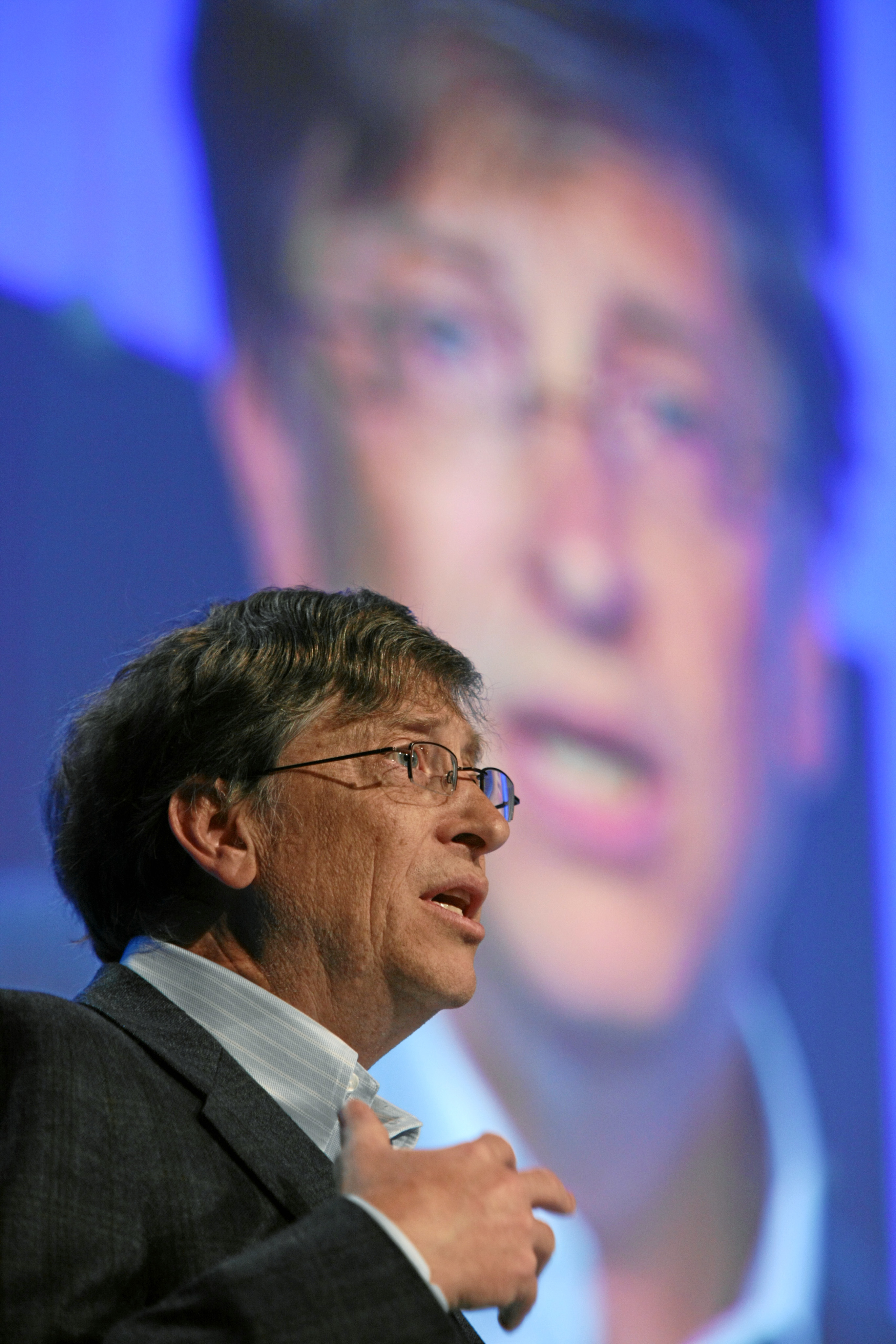
January 24, 2008
In his final Davos appearance as a full-time Microsoft employee, Gates delivered the speech 'A New Approach to Capitalism in the 21st Century,' introducing the concept of creative capitalism — a hybrid engine of self-interest and concern for others that extends market benefits to the world's poorest. He argued that pure capitalism leaves the poorest two billion people without market incentives to serve them, and called on corporations and governments to align profits with social outcomes. The speech generated global debate and was later compiled into an anthology book.
March 12, 2008
Gates returned to Capitol Hill to testify before the House Committee on Science and Technology, warning that immigration restrictions were eroding America's global technology lead. He noted that H-1B visas for fiscal year 2008 were exhausted on April 2, 2007 — within one day of the application window opening — as proof that demand vastly exceeded the cap. He renewed calls to extend work authorization for foreign STEM graduates, raise the H-1B ceiling, and create a clear path to permanent residency for high-skilled workers. The testimony prompted multiple immigration reform bills to be introduced that month.
2007
A long-running Iowa class-action antitrust case, Comes v. Microsoft, forced the company to disclose thousands of internal emails and memos that proved deeply embarrassing — candid messages in which executives discussed blunting rivals and wielding the company's market power. Before Microsoft settled the case in 2007, the so-called 'Iowa documents' became a widely cited trove of evidence about its anticompetitive culture during the Gates era, offering an unusually frank window into how the company actually operated behind closed doors.
2007
In 2007 Microsoft made what was then its largest-ever acquisition, buying digital-advertising firm aQuantive for about $6.3 billion in an all-cash deal meant to help it compete with Google in online ads. The bet largely failed: Microsoft's online-advertising business kept losing money, and in 2012 the company wrote down roughly $6.2 billion of the acquisition's value — nearly the entire purchase price — one of the biggest write-offs in its history. The episode underscored how hard it was for Microsoft to crack Google's dominance in search advertising.
July 2007
Microsoft announced the opening of a new development centre in Richmond, British Columbia — explicitly citing the US H-1B visa system's failure to allow the company to hire the talent it needed. In 2007, US immigration services had received 150,000 H-1B applications in a single day — more than double the annual quota of 65,000. The Vancouver facility, planned for 700–1,000 employees, allowed foreign workers to establish residency in Canada and then qualify for an intracompany transfer to the United States, bypassing the H-1B lottery. CEO Steve Ballmer said plainly: 'We opened a lab because we were having trouble getting visas for the best and the brightest.'
2007
Gates consistently advocated for automatically granting U.S. permanent residency to foreign nationals who earn advanced STEM degrees from American universities — described as stapling a green card to every STEM diploma. He argued that training the world's top engineers then forcing them to leave was economic self-harm that enriched rival economies. The proposal became a defining demand of the tech industry's immigration reform agenda and was repeatedly introduced as standalone legislation in Congress during Gates's active advocacy period.
March 7, 2007
Gates testified before the U.S. Senate Committee on Health, Education, Labor, and Pensions, urging Congress to lift the 65,000 annual cap on H-1B visas for highly skilled foreign workers, which he called arbitrarily set. He proposed three specific reforms: extending post-graduation work authorization for foreign STEM students; creating a streamlined path to permanent residency for high-skilled foreign-born employees; and increasing the green card cap. Gates argued that limits on skilled immigration were eroding U.S. innovation leadership and effectively exporting talent to competitor nations.
2006
In late December 2005, Microsoft removed the popular MSN Spaces blog of Chinese journalist Zhao Jing (who wrote under the name Michael Anti) after he criticized the government-ordered firing of editors at a Beijing newspaper. Because the blog was hosted on U.S.-based servers, the deletion erased it worldwide, not just inside China. The Committee to Protect Journalists and other groups condemned the move, and it became a flashpoint in the debate over American tech companies complying with Chinese censorship. Microsoft, then chaired by Bill Gates, defended acting in accordance with local law but said it would afterward remove content only on formal legal demand and keep it visible outside the country involved.
2005
After the European Commission's 2004 antitrust ruling, Microsoft was required to sell a version of Windows without its bundled Media Player, released in 2005 as 'Windows XP N.' The product was a near-total commercial failure: by April 2006 only about 1,787 copies had been sold — roughly 0.005 percent of Windows XP sales in Europe — and Microsoft acknowledged in court that no PC maker shipped it. Critics noted that Microsoft priced the stripped-down version the same as the full one and gave consumers no incentive to choose it, blunting the remedy regulators had imposed. The episode was cited as an example of how Microsoft complied with antitrust orders in form while undercutting them in practice.
2005
In December 2005, South Korea's Fair Trade Commission fined Microsoft roughly $32 million and ordered it to offer versions of Windows stripped of its bundled Media Player and instant-messaging software, following complaints from Korea's Daum Communications and RealNetworks. Regulators concluded that tying those programs to the dominant Windows operating system harmed competition. Microsoft appealed and at one point publicly warned it might withdraw Windows from the South Korean market, but the commission upheld its decision. The case mirrored antitrust findings against Microsoft in the United States and Europe over the same bundling practices.
2005
In 2005, Microsoft agreed to pay RealNetworks $761 million to settle an antitrust suit alleging that Microsoft had used its Windows monopoly to crush Real's media player by bundling Windows Media Player into the operating system for free. The settlement — roughly $460 million in cash plus $301 million in cash and services — was one of several large payouts Microsoft made in the 2000s to rivals it had been found or accused of harming. It underscored how the bundling tactics that helped build Microsoft's dominance under Bill Gates carried a steep legal price.
2005
In litigation with the small streaming-media firm Burst.com — which accused Microsoft of misappropriating its technology — Microsoft was alleged to have destroyed evidence via a policy of deleting employee email after 30 days. Burst pointed to a January 2000 message from Windows chief Jim Allchin instructing staff: 'Do not archive your mail… 30 days.' Microsoft said it had complied with discovery and that the deletions were routine policy, but the dispute fed broader concerns that the company purged records sought in lawsuits. Microsoft settled with Burst.com for $60 million in 2005.
April 2005
Bill Gates publicly called for the complete removal of all numerical caps on H-1B visas, which then stood at 65,000 annually. Speaking about the severe talent shortage facing Microsoft and the US technology sector, Gates stated 'I don't think there should be any limit' — the most direct rejection of skilled immigration restrictions he had yet made. He argued that the caps were an arbitrary constraint with no relationship to the economy's actual need for skilled workers, and that US firms were already sending positions offshore or to Canada rather than leave them unfilled.
2004
In 2004, Japan's Fair Trade Commission issued a formal recommendation finding that a 'non-assertion of patents' clause in Microsoft's licensing contracts with Japanese PC makers violated the country's antimonopoly law. The clause barred manufacturers from suing Microsoft — or one another — for infringing their patents in Windows, which regulators said discouraged Japanese firms from developing their own technologies and undermined fair competition. It was described as the first such action against the clause by any regulator. After Microsoft contested the finding, the JFTC issued a cease-and-desist order in 2008 requiring it to stop enforcing the provision. The case was part of a wave of global antitrust scrutiny of Microsoft's contract terms.
2004
In November 2004, Microsoft agreed to pay Novell $536 million to resolve antitrust claims related to Novell's NetWare networking software. The same month, Novell filed a separate antitrust suit alleging that, a decade earlier, Microsoft had deliberately withheld key Windows 95 technical information after luring Novell into developing its WordPerfect word processor for the new system — sabotaging WordPerfect so Microsoft Word could dominate. Microsoft denied the claims, and after years of litigation the courts ultimately ruled in Microsoft's favor on the WordPerfect allegations, a result upheld on appeal. The disputes illustrated longstanding accusations that Microsoft manipulated access to Windows to disadvantage rival applications.
2004
In April 2004, Microsoft agreed to pay Sun Microsystems about $1.6 billion — roughly $700 million to settle Sun's antitrust claims and $900 million over patents — to end years of bitter litigation, much of it centered on Sun's cross-platform Java technology, which Sun accused Microsoft of trying to fracture. The deal, struck while Bill Gates was chairman and chief software architect, also launched a surprise cooperation pact between the longtime rivals. It was one of a string of large settlements Microsoft paid to clear the legal overhang from its antitrust era.
2004
In 2004 Microsoft announced a one-time special dividend of $3.00 per share — about $32 billion in total — then the largest cash payout in corporate history, part of a plan to return up to $75 billion to shareholders. As the biggest shareholder, Bill Gates received more than $3 billion, which he donated to the Gates Foundation. The payout reflected the extraordinary cash Microsoft's Windows-and-Office monopoly generated.
March 24, 2004
The European Commission issued a landmark ruling against Microsoft, imposing a 497 million euro fine — the largest ever levied by the EU against a single company at that time — for illegally tying Windows Media Player to the Windows operating system and refusing to disclose interoperability information to competitors. The ruling required Microsoft to release a version of Windows without Media Player in Europe. Gates and Microsoft ultimately paid the fine and complied with the technical requirements after years of additional proceedings before the EU Court of First Instance.
2003
In May 2003, Microsoft agreed to pay AOL Time Warner $750 million to settle an antitrust lawsuit filed in 2002 on behalf of its Netscape unit. The suit alleged that Microsoft had used illegal, strong-arm tactics — chiefly bundling Internet Explorer free with Windows — to crush Netscape's pioneering web browser and seize control of the market. The settlement, one of the largest Microsoft paid over its browser practices, also gave AOL a seven-year royalty-free license to use Internet Explorer. Netscape's collapse had been central to the U.S. government's antitrust case against Microsoft during Bill Gates's leadership.
2003
Be Inc., maker of the well-regarded BeOS operating system, filed an antitrust suit against Microsoft in February 2002, alleging that Microsoft's exclusionary licensing terms with PC manufacturers had prevented them from offering BeOS — even as a dual-boot option — and helped drive Be out of business. In September 2003, Microsoft agreed to pay $23.25 million (after attorneys' fees) to settle the case, while admitting no wrongdoing. Be, which had already sold its assets and wound down, had argued that Microsoft's contracts effectively foreclosed rival operating systems from the market. The settlement was one of a series of payouts Microsoft made in the 2000s to competitors it had been accused of harming.
2003
In 2003 Microsoft declared its first-ever dividend, beginning to return some of its enormous cash pile to shareholders rather than reinvesting all of it. As the company's largest individual shareholder, Bill Gates was among the biggest beneficiaries — income he largely channeled into the Gates Foundation — and the move signaled Microsoft's maturation from a hyper-growth startup into an established blue-chip company.
2003
Gates's private investment vehicle, Cascade Investment LLC, began acquiring agricultural land in Washington State and the Pacific Northwest in the early 2000s, structured through limited liability companies in a manner consistent with Cascade's broader strategy of low-profile, long-horizon asset accumulation. The purchases were not disclosed at the time and only became known through investigative reporting and county property-record analysis in the following decade.
2002
Sendo, a British mobile-phone start-up, partnered with Microsoft to build one of the first Windows smartphones, then abruptly dropped Microsoft in late 2002 for the rival Symbian platform. In December 2002, Sendo sued Microsoft, alleging that Microsoft had used the partnership to extract Sendo's proprietary technology and trade secrets and then funneled them to a competitor. Microsoft denied the allegations and filed a countersuit for breach of contract. The companies settled in 2004, with both sides denying liability; Microsoft surrendered its roughly 4 percent stake in Sendo and paid an undisclosed sum. The case added to a pattern of partners accusing Microsoft of appropriating their technology.
2002
After Microsoft reached a 2001 settlement with the U.S. Justice Department and several states over its antitrust violations, nine states — including California, Massachusetts, Iowa and Connecticut — plus the District of Columbia refused to sign, arguing the deal was too weak to curb the company's conduct. They pressed for tougher remedies, including stricter oversight of Microsoft's contracts. In November 2002, U.S. District Judge Colleen Kollar-Kotelly approved a final judgment that largely mirrored the federal settlement and declined to impose the broader restrictions the dissenting states sought. Critics argued the outcome let Microsoft off lightly given that courts had found it an illegal monopoly.
2002
In 2002 Microsoft acquired Danish business-software maker Navision for roughly $1.4 billion, deepening the enterprise-applications push it had begun with Great Plains a year earlier. The Navision and Great Plains products became core pieces of what is now Microsoft Dynamics, reflecting Bill Gates and Steve Ballmer's strategy to sell software deep into the operations of midsize businesses.
2001
In June 2001, the U.S. Court of Appeals for the D.C. Circuit unanimously removed U.S. District Judge Thomas Penfield Jackson from the Microsoft antitrust case, finding he had created an appearance of bias by giving secret interviews to journalists during the trial. Jackson had disparaged Microsoft to reporters — reportedly comparing Bill Gates to Napoleon and likening the company's executives to stubborn 'gang members' in remarks later published, including in The New Yorker. The appeals court called his conduct a serious breach of judicial ethics, vacated his order breaking Microsoft in two, and sent the case to a new judge. It was a significant setback for the government even as the court upheld that Microsoft was an illegal monopoly.
2001
In 2001, the Los Angeles Times exposed a covert 'astroturf' campaign defending Microsoft during its antitrust battle: a Microsoft-funded front group, Americans for Technology Leadership, helped generate hundreds of seemingly grassroots letters to newspapers and officials opposing the government's case — some of them, reporters found, sent in the names of deceased people or from nonexistent addresses. The manufactured-public-support effort, run while Gates led Microsoft, became a textbook example of corporate astroturfing and intensified scrutiny of the company's hardball public-relations tactics.
2001
Through Corbis, the digital-image company he founded in 1989, Bill Gates owned one of the world's great photographic collections — including the storied Bettmann Archive of some 11 million historic photos. To halt the images' decay, Corbis moved the archive in 2001 into a sub-zero, high-security vault built 220 feet underground in a former Pennsylvania limestone mine. The deep-freeze preservation is expected to extend the negatives' life by centuries, though some critics lamented that placing the originals literally underground put iconic images further out of public reach.
2001
In 2001 Microsoft completed its roughly $1.1 billion acquisition of Great Plains Software, a Fargo-based maker of accounting and business-management software for midsize companies. The deal marked Microsoft's serious entry into enterprise business applications and became the foundation of what is now Microsoft Dynamics. It signaled the company's push, under Bill Gates and successor Steve Ballmer, to sell software deeper into the back offices of businesses, beyond Windows and Office.
November 2001
The Department of Justice under Attorney General John Ashcroft reached a consent decree with Microsoft that settled the landmark antitrust case without forcing a corporate breakup. The settlement required Microsoft to share its application programming interfaces with third-party companies and installed a compliance committee with access to Microsoft's systems. Critics, including several state attorneys general, argued the settlement was too lenient. The case is now studied in law schools as a defining example of the tension between innovation policy and antitrust enforcement in the technology industry.
June 28, 2001
The United States Court of Appeals for the D.C. Circuit unanimously overturned Judge Jackson's order to break Microsoft into two companies, handing Gates a major legal victory. The court found that Jackson had committed serious misconduct by secretly discussing the case with journalists while it was pending, and that the breakup remedy was disproportionate. The appeals court vacated the order entirely and remanded the case to a new judge — effectively saving Microsoft's corporate structure and giving the incoming Bush-era DOJ grounds to negotiate a settlement rather than pursue a full breakup.
2000
For years Microsoft staffed parts of its workforce with long-term 'permatemps' — workers labeled temporary or freelance who often worked alongside regular employees for years without the same benefits, including the lucrative employee stock-purchase plan. In Vizcaino v. Microsoft, the Ninth Circuit Court of Appeals ruled that Microsoft had exercised enough control over these workers that they were effectively employees entitled to those benefits. In 2000, Microsoft agreed to pay $97 million to settle the long-running class action covering thousands of workers. The case became a landmark in U.S. labor law on the misclassification of contingent workers and prompted Microsoft to change its staffing practices.
2000
In January 2000, Microsoft completed its acquisition of Seattle-based Visio Corporation — maker of the popular diagramming software — for about $1.5 billion in stock, then the largest acquisition in Microsoft's history. Folded into the Office family, Visio became the company's standard tool for flowcharts, org charts, and technical diagrams. The deal, closed as Bill Gates handed the CEO role to Steve Ballmer, reflected Microsoft's strategy of buying its way into productivity niches to extend the Office franchise.
January 2000
On the eve of trial in January 2000, Microsoft settled a long-running antitrust and unfair-competition lawsuit brought by Caldera, which had acquired the rival operating system DR-DOS. Caldera alleged Microsoft used predatory tactics to crush DR-DOS, including the so-called 'AARD code' — hidden instructions in beta versions of Windows that displayed cryptic, non-fatal error messages when they detected DR-DOS instead of MS-DOS, designed to make the competitor look unreliable. The settlement terms were confidential, but Microsoft later disclosed a figure of roughly $155 million, with some outside estimates higher. The case is frequently cited as documentary evidence of the hardball tactics Microsoft used against competitors during Bill Gates's leadership.
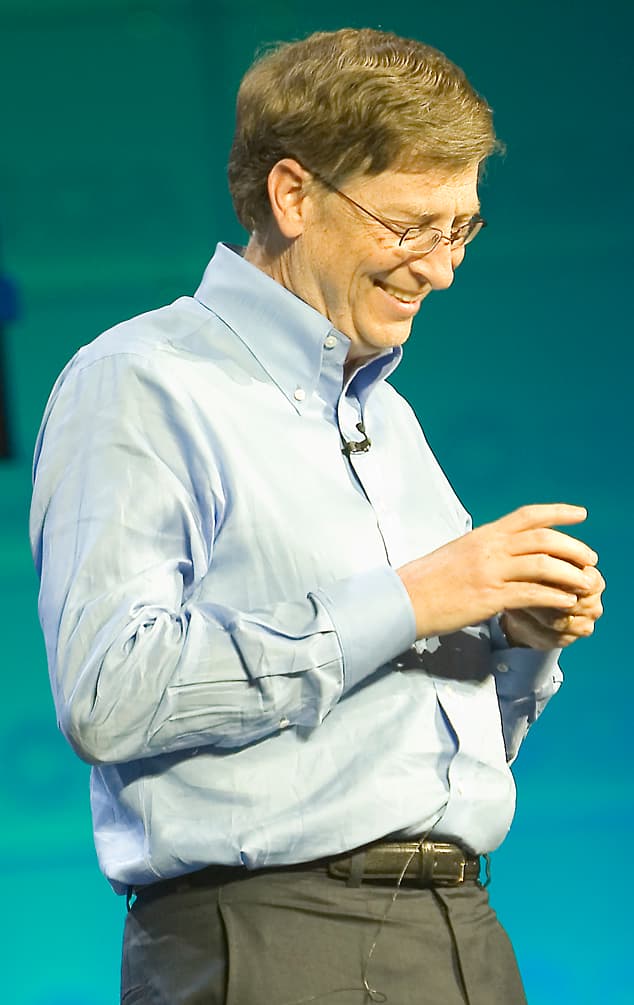
June 28, 2000
U.S. District Judge Thomas Penfield Jackson issued a sweeping remedy order requiring Microsoft to be split into two separate companies: one selling the Windows operating system and one selling all other software products. Jackson had previously ruled that Microsoft had illegally maintained its Windows monopoly and unlawfully tied Internet Explorer to the OS. The breakup order was the most severe antitrust remedy sought against a technology company since the AT&T split of 1984 and is widely cited as a key catalyst in Gates's decision to step down as CEO.
January 13, 2000
Gates resigned as Microsoft's Chief Executive Officer after 25 years and handed the role to Steve Ballmer, assuming the title of Chief Software Architect. The transition came as Microsoft's market capitalization briefly touched $586 billion — the highest of any publicly traded company at that time. Gates retained the non-executive chairmanship of the board until 2014 and continued to influence technical direction until his full-time departure in 2008.
1999
Bristol Technology, a small software firm, sued Microsoft after Microsoft sharply changed the licensing terms for the Windows source code Bristol needed to port Windows applications to Unix. In July 1999, a federal jury in Connecticut found that Microsoft had committed a deceptive act in violation of the state's Unfair Trade Practices Act, though it rejected Bristol's broader antitrust claims and awarded only $1 in nominal damages. The trial judge afterward granted a permanent injunction and additional punitive damages under the state statute, and Microsoft separately reached a settlement. The case offered an early courtroom finding that Microsoft had dealt deceptively with a dependent software partner.
1999
Testimony at Microsoft's 1999 antitrust trial detailed how the company punished IBM for supporting rival software. IBM executive Garry Norris recounted that because IBM kept shipping its competing OS/2 operating system and SmartSuite applications, Microsoft charged IBM higher prices for Windows and withheld technical help — at one point IBM faced paying far more for Windows 95 than rivals did, with a discount dangled in exchange for dropping OS/2. Microsoft later paid IBM $775 million, in 2005, to settle related antitrust claims. The account illustrated the coercive tactics Gates's company used to protect the Windows monopoly.
1999
Amid the late-1990s technology boom, the soaring price of Microsoft stock briefly pushed Bill Gates's net worth past $100 billion in 1999, making him the first person ever to reach that figure — a 'centibillionaire' — on paper. The peak (commonly reported around $101 billion) reflected his roughly 18% stake in the company at the height of the dot-com bubble; adjusted for inflation it would be well over $150 billion in today's dollars. No one else would join the $100-billion club until Jeff Bezos in 2017. Gates's fortune later fell as the bubble burst and as he transferred tens of billions of dollars to his foundation.
March 1999
Gates published 'Business @ the Speed of Thought,' arguing that companies able to use digital information systems to respond as quickly as they thought would decisively outcompete those that couldn't. The book debuted at number one on the New York Times bestseller list and was translated into 25 languages. Gates donated all proceeds from the book to non-profit programs providing technology training to underserved communities.
1998
In August 1998, Bill Gates sat for roughly 20 hours of videotaped deposition questioning by government lead attorney David Boies ahead of Microsoft's antitrust trial. When excerpts were played in court that November, Gates came across as combative and evasive, quarreling over the meaning of ordinary words such as 'compete,' 'concerned,' and 'we,' and repeatedly saying he could not recall key events. According to contemporaneous reporting, the presiding judge laughed aloud at some of the exchanges. Gates later complained that Boies had asked imprecise questions and was out to damage Microsoft; legal observers nonetheless cited the performance as a costly misstep that undercut the company's credibility during the trial.
1998
During the United States v. Microsoft antitrust trial in 1998, Intel executive Steven McGeady testified that a senior Microsoft executive, Paul Maritz, had described the company's approach to rivals as 'embrace, extend, and extinguish' — adopt an open industry standard, add proprietary extensions that work best only with Microsoft products, and thereby marginalize competitors. Internal emails entered as evidence showed the tactic aimed at technologies such as Sun's cross-platform Java and Netscape's web software. The phrase, attributed to the company under Bill Gates's leadership, became enduring shorthand for using compatibility as a competitive weapon and is still invoked in debates over platform power.
October 19, 1998
The U.S. Department of Justice and twenty state attorneys general filed antitrust suits against Microsoft, alleging it had illegally maintained its Windows monopoly and suppressed competition in the browser market. Gates testified under deposition for three days, and the trial ran for 207 days of testimony. Judge Thomas Penfield Jackson initially ordered Microsoft split into two companies; that remedy was overturned on appeal and Microsoft settled in 2001, reshaping how it conducted business for years afterward.
1997
Microsoft built the first versions of Internet Explorer on Mosaic browser technology it licensed in 1995 from Spyglass Inc., under a deal giving Spyglass a quarterly fee plus a percentage of Microsoft's browser revenue. Microsoft then bundled Internet Explorer into Windows for free — generating essentially no direct browser revenue and so paying Spyglass only the minimum quarterly fee, a fraction of what the smaller firm had expected. After Spyglass complained and threatened an audit, Microsoft agreed in January 1997 to convert the arrangement into a fully paid-up license for an additional $8 million. The episode became a textbook example of how Microsoft used the leverage of free bundling to undercut a partner, foreshadowing the browser tactics at the heart of its antitrust case.
1997
At Microsoft's 1998 antitrust trial, Apple senior executive Avie Tevanian testified that in 1997 Microsoft pressured Apple to abandon its QuickTime multimedia software and cede the playback market. According to evidence in the case, at an April 1997 meeting an Apple engineer asked whether Microsoft wanted Apple to 'knife the baby' — meaning QuickTime — and a Microsoft executive replied, 'Yes, we're talking about knifing the baby.' Tevanian, who acknowledged he had not personally attended that meeting, said that when Apple refused, Microsoft worked to sabotage QuickTime's compatibility with Windows. Microsoft disputed Tevanian's characterization and called the discussions ordinary business negotiations, but the vivid phrase became one of the trial's most-quoted moments.
1997
In 1997 Microsoft acquired WebTV Networks for about $425 million ($190 million cash and $235 million in stock), betting that consumers would browse the internet through their televisions using set-top boxes and remote controls. Folded into Microsoft and later rebranded MSN TV, the product never achieved mass adoption as PCs and, later, smartphones became the dominant gateways to the web. The deal was an early sign of Bill Gates's eagerness to put Microsoft into every screen in the home.
1997
On August 6, 1997, at the Macworld Expo in Boston, a struggling Apple announced that rival Microsoft would invest $150 million in the company and keep developing Microsoft Office for the Mac. Steve Jobs, newly back at Apple, unveiled the deal as a smiling Bill Gates appeared on a giant screen via satellite — to audible boos from some Apple loyalists. The agreement, which also settled patent disputes and made Internet Explorer the Mac's default browser, helped keep Apple afloat at a low point, a striking truce between the two tech icons.
December 31, 1997
Microsoft acquired Hotmail for an estimated $400 million, making it the company's largest acquisition to that date. Hotmail had launched only 18 months earlier and already had 8.5 million subscribers — the largest webmail service in the world. Gates recognized web-based email as a strategic asset and rebranded the service MSN Hotmail. It eventually evolved into Outlook.com, which now serves more than 400 million users.
1996
The online-travel giant Expedia began life inside Microsoft. Launched in 1996 after Richard Barton pitched the idea to Bill Gates — who approved it on the spot — Microsoft Expedia let people book flights and hotels over the web, an early bet on internet commerce. Microsoft spun Expedia off as a public company in 1999 and sold its stake to USA Networks for about $1.5 billion in 2001. Expedia grew into one of the world's largest travel companies, an enduring product of Gates-era Microsoft's internet push.
1996
In 1996 Microsoft moved into media: it partnered with NBC to launch MSNBC, a 24-hour cable news channel paired with a news website, and bankrolled Slate, an online magazine led by journalist Michael Kinsley. The ventures reflected Bill Gates's conviction that the internet would reshape news and publishing — and his appetite to place Microsoft at the center of online content. Microsoft eventually exited both, but the bets were early signs of the web's coming disruption of traditional media.
1995
In October 1994, Microsoft agreed to buy Intuit, maker of the dominant Quicken personal-finance software, for about $1.5 billion — what would have been the largest software merger to that point. The U.S. Justice Department sued on April 27, 1995, to block the deal, warning that combining Quicken (which held roughly 75 percent of the market) with Microsoft's Money product would raise prices and chill innovation. Rather than fight a prolonged antitrust battle, Microsoft called off the acquisition in May 1995 and paid Intuit a $46.25 million termination fee. It was an early instance of regulators blocking Bill Gates's Microsoft from expanding through acquisition.
1995
At Microsoft's 1998 antitrust trial, Intel executive Steven McGeady testified that Bill Gates had, in a 1995 meeting, bluntly threatened Intel — warning that Microsoft would not support Intel's next-generation chips unless Intel halted its 'Native Signal Processing' software work, which Microsoft viewed as encroaching on Windows. Intel, whose processors needed Windows to sell, backed down; chairman Andy Grove later acknowledged Intel 'caved' under Microsoft's pressure. Entered into the federal antitrust record, the episode became a vivid example of how Gates used Microsoft's platform power to keep even powerful partners in line.
1995
At a June 21, 1995 meeting that later became central to the U.S. government's antitrust case, Microsoft executives allegedly proposed that the upstart Netscape divide the web-browser market — ceding the Windows 95 market to Microsoft in exchange for being left alone elsewhere — and signaled consequences if it refused. Netscape's account, supported by co-founder Marc Andreessen's contemporaneous notes and CEO Jim Barksdale's testimony, framed the overture as an illegal attempt to carve up a market; Microsoft disputed that characterization and accused Netscape and prosecutors of staging a 'setup.' Occurring under Bill Gates's leadership, the episode came to symbolize the hardball tactics that triggered United States v. Microsoft.
September 1995
Bill Gates visited China and was received with diplomatic protocol typically reserved for foreign heads of state, meeting privately with President Jiang Zemin at a state resort. The visit reflected the Chinese government's strategic interest in Microsoft's role in China's technology modernization and cemented the relationship that would underpin Microsoft's expansion through the late 1990s and 2000s.
1995
Forbes magazine named Gates the wealthiest person in the world for 18 of the 24 years between 1995 and 2018 — more times than any other individual in the modern era of the Forbes Billionaires List. His wealth peaked at approximately $136 billion in 2019 before decades of philanthropy reduced his net worth significantly. Gates has said he intends to give away virtually all his wealth and eventually drop off the billionaires list entirely.
1994
GO Corporation, founded in 1987 by Jerry Kaplan, was an early pen-computing pioneer whose PenPoint operating system collapsed amid competition from Microsoft's rival Pen Windows. In his memoir 'Startup' and in a later lawsuit, Kaplan alleged that Microsoft had obtained GO's confidential technology under the guise of a partnership and used it to build its competing product, helping doom the company. Kaplan filed an antitrust suit against Microsoft in 2005; Microsoft denied wrongdoing, and the courts ultimately dismissed the case as barred by the statute of limitations, a ruling affirmed by the Fourth Circuit in 2007. The dispute remains a frequently cited account of how Microsoft was accused of crushing smaller innovators during Gates's tenure.
1994
Decades before Starlink, Bill Gates chased satellite internet. In the early 1990s he teamed with cellular billionaire Craig McCaw to back Teledesic, an audacious plan to blanket the planet with hundreds of low-orbit satellites — originally 840 — delivering high-speed 'internet in the sky.' Teledesic raised close to a billion dollars from backers including Boeing, Motorola, and a Saudi prince, but launched only a single test satellite before collapsing; it suspended work in 2002. The failure foreshadowed both the promise and the difficulty of the satellite-broadband bets Gates would keep making for decades.
1994
The U.S. government's first antitrust action against Microsoft targeted a coercive licensing scheme. For years the company used 'per-processor' contracts that made PC makers pay Microsoft a royalty on every machine of a given type they sold — even ones that did not run a Microsoft operating system — effectively penalizing manufacturers for installing rival software. In July 1994 the Justice Department sued, and Microsoft signed a consent decree banning the practice. Reached while Bill Gates was CEO, it was an early official finding that Microsoft used its dominance to choke off competition.
February 1994
In February 1994, a Los Angeles federal jury found that Microsoft had infringed two data-compression patents held by Stac Electronics, whose Stacker software let users fit more data onto a hard disk; Microsoft had added a similar 'DoubleSpace' feature to MS-DOS 6 after licensing talks with Stac broke down. The jury awarded Stac $120 million — the first patent suit against Microsoft to reach trial — while granting Microsoft $13.6 million on a counterclaim that Stac had misappropriated trade secrets. Rather than keep fighting, the companies settled months later, with Microsoft taking a stake in Stac and paying royalties. The verdict was an early, high-profile legal setback for the Gates-led company.
1994
Gates established Cascade Investment LLC as his private investment vehicle to manage his personal wealth outside of Microsoft. Under the long-tenured management of Michael Larson, Cascade diversified aggressively into real estate, hospitality (becoming a major stakeholder in Four Seasons Hotels and AutoNation), agriculture, and infrastructure. Cascade's patient, value-oriented strategy has grown Gates's non-Microsoft fortune substantially and allowed him to fund charitable commitments at scale. The firm operates with exceptional discretion and is one of the most influential family investment offices in the world.
1993
The U.S. government's scrutiny of Microsoft began not with the famous 1998 trial but with a Federal Trade Commission investigation opened in 1990, after Microsoft and IBM split over operating systems. The probe examined whether Microsoft was using its dominance over PC operating systems to stifle competition. According to The Washington Post, the FTC commissioners deadlocked twice — on February 5 and again on July 21, 1993 — failing to muster a majority to authorize a complaint, with one commissioner recused over a conflict. The stalemate effectively ended the FTC's case, but the Justice Department took over the inquiry, leading to Microsoft's 1994 consent decree and, ultimately, the landmark antitrust litigation of the late 1990s.
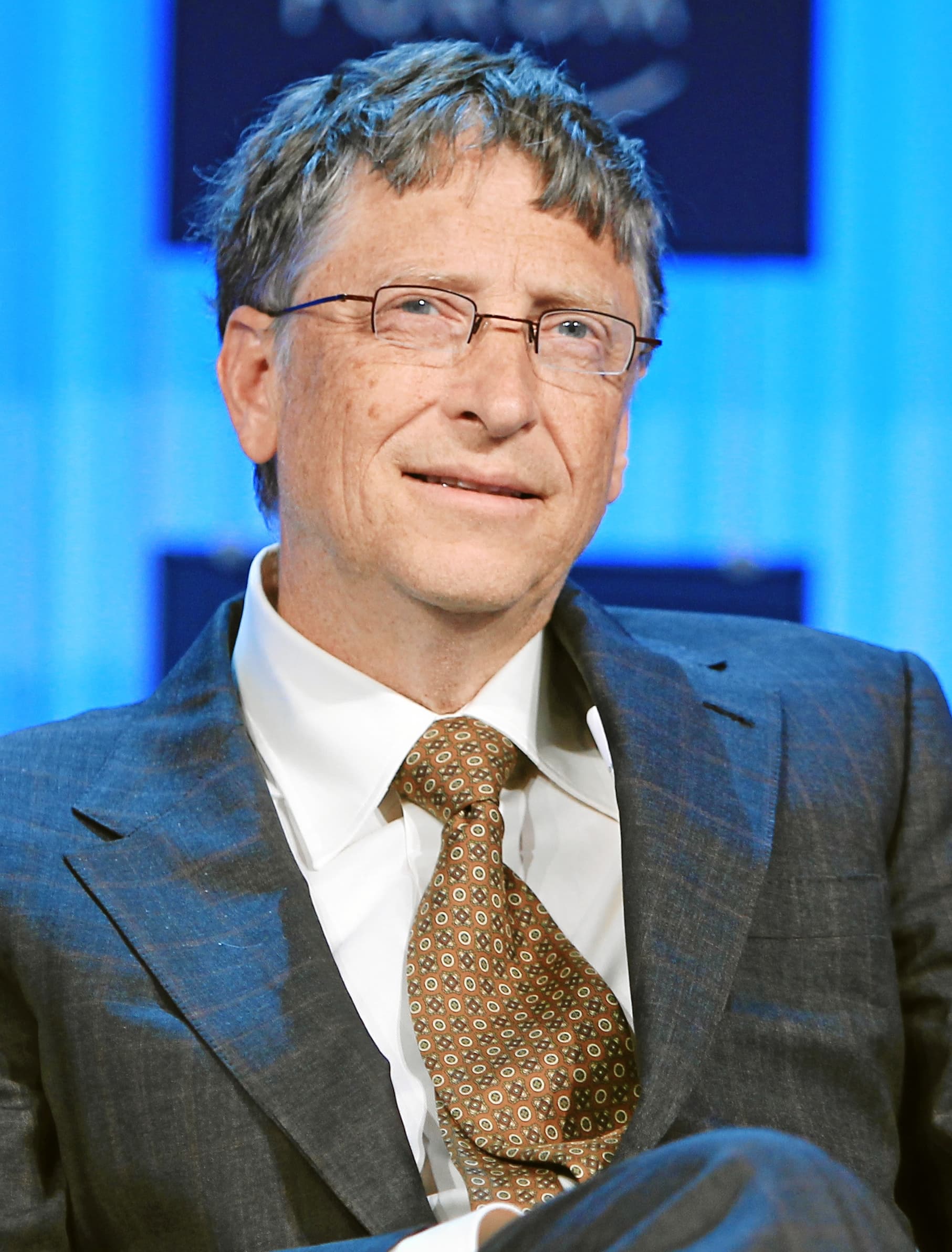
September 11, 1993
Gates joined Warren Buffett's Berkshire Hathaway as an independent board director, cementing one of the most consequential personal friendships in the history of American capitalism. Over the following decades, Buffett and Gates became the primary architects of the Giving Pledge, collectively redirecting hundreds of billions of dollars toward global philanthropy. Gates served on the Berkshire board for 24 years before stepping down in 2020 to concentrate on the Gates Foundation. Their relationship transformed how the world's wealthiest individuals think about charitable giving.
1992
Bill Gates's early reputation as a boss was famously harsh. The 1992 biography 'Hard Drive: Bill Gates and the Making of the Microsoft Empire' documented his combative, intensely demanding style — late-night 'flame mail,' blunt put-downs (a programmer might get a 2 a.m. message beginning 'This is the stupidest piece of code ever written'), and a confrontational culture that drove Microsoft's breakneck growth. Gates has acknowledged he 'wasn't a sweetheart' and was tough on staff in those years, likening his intensity to a demanding coach; many employees nonetheless described him as inspiring and brilliant.
1990
In 1990, Bill Gates was an original investor in ICOS, a Bothell, Washington biotech that launched with about $33 million — then the largest venture financing in biotech history. Gates held roughly an 8% stake and sat on the board until 2005. ICOS became best known for developing tadalafil, marketed as the erectile-dysfunction drug Cialis, and in 2006 was acquired by its partner Eli Lilly for about $2.1 billion. The investment was an early sign of Gates's enduring interest in the life sciences, long before the Gates Foundation made global health his focus.
1990
In its 1990 fiscal year Microsoft became the first personal-computer software company to exceed $1 billion in annual sales, reporting revenue of roughly $1.18 billion with about 5,600 employees. The milestone, reached the same year it launched the breakthrough Windows 3.0, confirmed the scale of the business Bill Gates had built in just 15 years.
1989
Gates founded Corbis (originally Interactive Home Systems) as a personal venture to build a comprehensive digital image archive for the anticipated era of digital displays and electronic publishing. Over two decades, Corbis amassed the world's largest privately held photography collection — including the historic Bettmann Archive of 11 million images spanning over 150 years — along with rights to works by major photographic agencies. The company pioneered commercial digital image licensing. In 2016, Corbis sold its content assets to Visual China Group, with the Bettmann Archive now managed by Getty Images.
August 1, 1989
Microsoft released Office 1.0 for the Apple Macintosh, bundling Word, Excel, and PowerPoint into a single discounted package for the first time. The product was later expanded to Windows and quickly became the standard productivity suite for businesses worldwide. Microsoft Office and its successor Microsoft 365 remained the company's highest-revenue product line for more than three decades, generating hundreds of billions of dollars in cumulative revenue.
1987
At the age of 31, Bill Gates became the youngest self-made billionaire in history, according to Forbes magazine, with a net worth of approximately $1.25 billion derived almost entirely from his Microsoft equity stake. Gates had kept his own salary deliberately modest while allowing Microsoft's market capitalization to compound following its 1986 IPO. The milestone made him a global symbol of entrepreneurial success in the technology industry.
1986
In 1986 Microsoft moved into a new corporate campus in Redmond, Washington — the same year it went public. What began as a cluster of buildings grew over the decades into a sprawling campus housing tens of thousands of employees, becoming the global headquarters from which Bill Gates directed the company and a symbol of the Seattle area's rise as a technology capital.
March 13, 1986
Microsoft went public on the NASDAQ at $21 per share, valuing the company at $778 million and raising $61 million. The stock closed its first day at $27.75. The IPO made Gates an instant multimillionaire and created a reported 12,000 millionaires among Microsoft employees and early investors over the following decade. It is regarded as one of the most consequential technology IPOs of the twentieth century.
1983
In November 1983, Bill Gates's Microsoft launched Microsoft Press, a book-publishing division created to produce high-quality manuals and guides for a computing public frustrated by poor software documentation. Its first titles included a guide to the IBM PCjr by Peter Norton and 'The Apple Macintosh Book.' Microsoft Press grew into a prolific technical publisher — an early sign of Gates's belief that helping people actually use computers mattered as much as making the software.
1981
One of the most consequential bargains in business history underpins Microsoft's empire. When IBM needed an operating system for its 1981 PC, Microsoft — which had none of its own — quietly bought 86-DOS (nicknamed QDOS, for 'Quick and Dirty Operating System') from Seattle Computer Products, reportedly for around $50,000, then licensed it to IBM as MS-DOS while keeping the rights to sell it to other PC makers. That arrangement, driven by Bill Gates, turned MS-DOS into the standard for IBM-compatible PCs and made Microsoft's fortune. Seattle Computer Products later sued, alleging it had been misled about the IBM deal, and the two sides settled.
1981
On June 25, 1981, Microsoft — until then a partnership between Bill Gates and Paul Allen — was reincorporated as a formal corporation in Washington state, with Gates as president and chairman and Allen as executive vice president. The restructuring came just as Microsoft's MS-DOS was about to ship on IBM's first personal computer, setting the legal foundation for the company's explosive growth.
1980
In 1980, Bill Gates persuaded his Harvard friend Steve Ballmer to drop out of Stanford's business school and join the young Microsoft as its first business manager — parting with about 4% of the company to do so. It proved one of the most consequential hires in business history: Ballmer became Gates's round-the-clock partner, later succeeded him as CEO, and the 4% stake he still held when he left in 2014 was worth well over $100 billion, making him one of the world's richest people. The deal showed Gates's willingness to give up equity to secure talent he believed Microsoft needed.
1980
Bill Gates has acknowledged that in Microsoft's earliest years he was so work-obsessed that he memorized the license plates of his employees' cars so he could tell from the parking lot who was arriving early and leaving late. 'I knew everybody's license plates so I could look out in the parking lot and see when did people come in, when were they leaving,' he told BBC Radio 4, adding that he 'didn't really believe in vacations' and eventually had to relax the practice as the company grew too large to track. The anecdote — corroborated in early Microsoft histories — captures the relentless, demanding culture Gates set at the company he co-founded.
1980
One of the most consequential moments in Microsoft's rise came through Bill Gates's mother, Mary Maxwell Gates, a prominent civic leader who served on the national board of United Way alongside IBM chairman John Opel. In 1980, as IBM sought an operating system for its first personal computer, Mary's acquaintance with Opel helped put tiny, five-year-old Microsoft on IBM's radar; Opel reportedly referenced the company 'run by Bill Gates, Mary Gates's son.' Microsoft won the deal to supply what became MS-DOS — the foundation of its decades-long dominance.
1979
Microsoft was founded in Albuquerque, New Mexico in 1975 to be near MITS, maker of the Altair computer. After the MITS relationship faded, Bill Gates and Paul Allen moved the young company in January 1979 to Bellevue, Washington — near their Seattle hometown — to tap local engineering talent. The relocation planted Microsoft in the Pacific Northwest, where it would later build its sprawling Redmond campus and help transform the region into one of the world's foremost technology hubs.
1978
A now-iconic photograph from December 1978 captures Microsoft as an 11-person startup in Albuquerque, New Mexico — a shaggy young Bill Gates seated front-left among the scruffy crew — taken just before the company moved to the Seattle area. Often shared with the caption 'would you have invested?', the picture became a symbol of unassuming beginnings: nearly everyone in it grew wealthy as Microsoft conquered the software world. It marked the end of Microsoft's Albuquerque era, where the company was founded to write software for the Altair.
1978
On November 1, 1978, Microsoft opened its first international office — 'ASCII Microsoft' in Japan — through a partnership with entrepreneur Kazuhiko 'Kay' Nishi, whom Bill Gates had befriended over a shared, intense temperament. Nishi became Microsoft's vice president for the Far East and brought in major Japanese customers such as NEC, helping Microsoft software spread across Japan's booming PC market. The Japan beachhead made the tiny Albuquerque company a global player years before Windows, and shaped products such as the MSX home-computer standard.
1977
Though Microsoft began as a partnership of two friends, Bill Gates pressed Paul Allen for the larger share of the company. By Allen's account in his memoir, Gates first proposed a 60/40 split in his own favor — arguing he had done more of the programming and carried more of the load — and then, after the partners licensed their BASIC interpreter to NCR, pushed it to 64/36. Allen reluctantly agreed. 'Bill knew that I would balk at a two-to-one split, and that 64 percent was as far as he could go,' Allen later wrote, concluding that Gates's thinking was simply 'what's the most I can get?' The split, set in the partnership's earliest years, left Gates with the controlling stake as Microsoft grew into one of history's most valuable companies.
February 3, 1976
On February 3, 1976, a 20-year-old Bill Gates published 'An Open Letter to Hobbyists' in the Altair users' newsletter of MITS, accusing the early personal-computer community of rampant software piracy. 'As the majority of hobbyists must be aware, most of you steal your software,' Gates wrote, estimating that fewer than 10 percent of Altair BASIC users had paid for it and asking, 'Who can afford to do professional work for nothing?' The letter — provoked by hobbyists freely copying Micro-Soft's Altair BASIC — drew an angry response from a computing culture built on sharing, and became an early, defining statement of Gates's hard-line stance on commercializing and protecting software.
1976
In February 1976 a 20-year-old Bill Gates published his 'Open Letter to Hobbyists,' rebuking early personal-computer enthusiasts who copied Microsoft's Altair BASIC without paying. 'Who can afford to do professional work for nothing?' Gates wrote, arguing that rampant copying would prevent good software from being written. The letter outraged a hobbyist culture that saw software as something to share freely, but it became an early and influential articulation of the idea that software is intellectual property worth paying for — a principle central to Microsoft's future.
[RELATED_SUBFILES] · ls ../
node: archive-01 · link: encrypted · uptime: 99.98% · mirror: active
— EOF · nothing here is hidden, only documented —